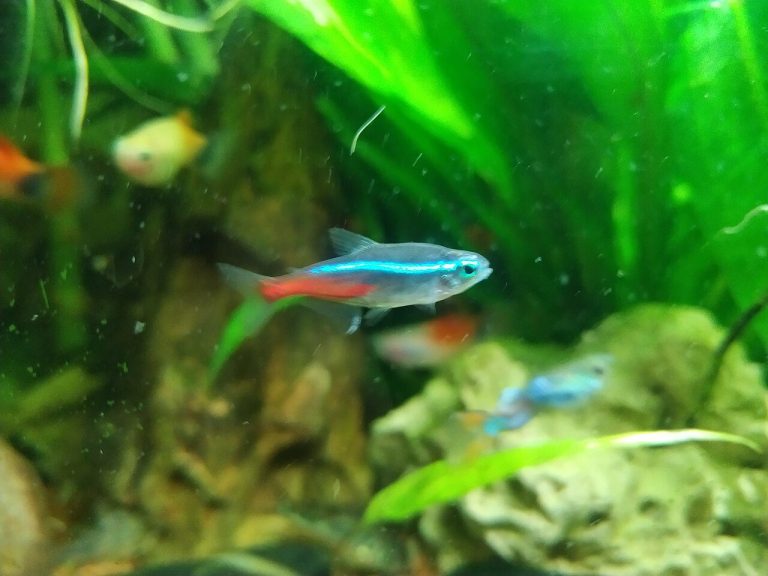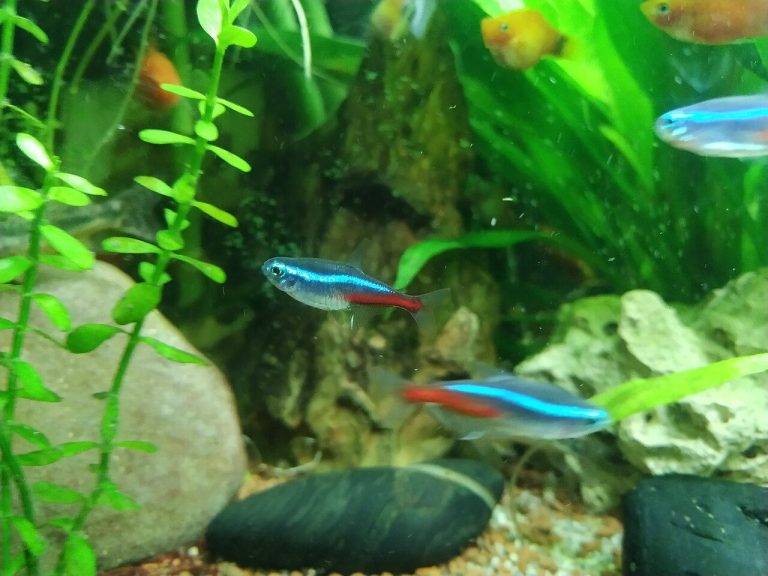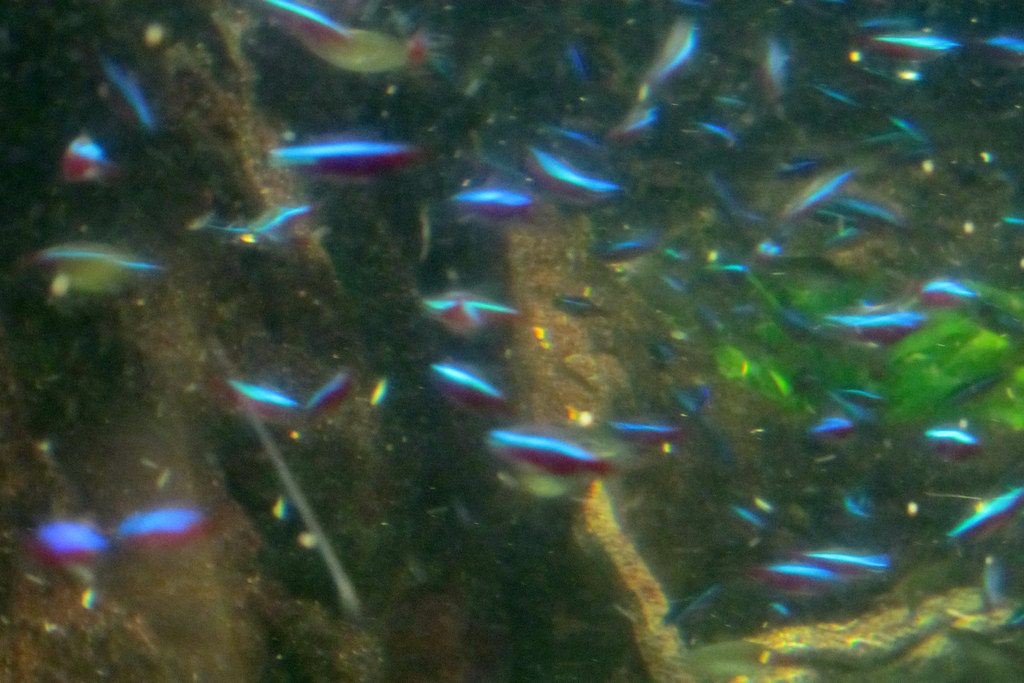
Neon Tetra Aquarium Setup – Setup Checklist
A successful neon tetra aquarium setup requires a minimum 10-gallon tank, soft and slightly acidic water (pH 6.0–7.0), stable temperatures between 72°F and 78°F, and dense live plants to provide essential security and mimic their natural habitat.
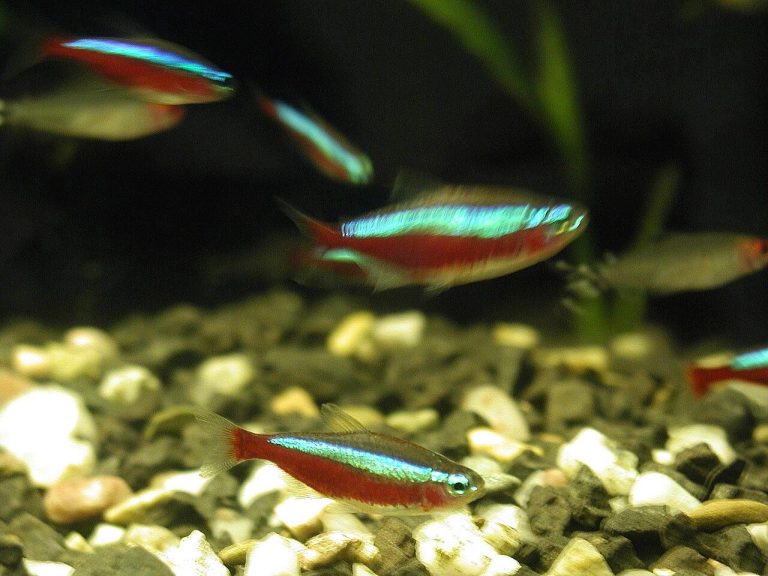
Few sights in the fish-keeping world are as iconic as a shimmering school of Paracheirodon innesi darting through a lushly planted tank.
In my fifteen years of maintaining South American biotopes, I have found that while these fish are widely available, they are often misunderstood.
A proper neon tetra aquarium setup is the difference between a fish that merely survives and one that displays the glowing electric blue and deep crimson colors they are famous for.
In this guide, I will share the exact steps I use to create an environment where these delicate tetras can do well for their full five-year lifespan.
At a glance: Neon tetra (Paracheirodon innesi)
- Temperature
- 72–78°F (22–26°C)
- Water pH
- 6.0–7.0
- Adult size
- 1.5 in (4 cm)
- Minimum tank
- 10 gal (20 gal for a proper school)
- Group size
- Groups of 8+
- Temperament
- Peaceful
- Diet
- Omnivore: micro pellets, flakes, frozen daphnia
- Lifespan
- 5–8 years
Keeper’s tip: Add neons only to a fully cycled, stable tank; they are among the first fish to suffer from ammonia swings.
Choosing the Perfect Tank for Your Neon Tetra Aquarium Setup
When people ask me for advice on their first neon tetra aquarium setup, the most common mistake I see is choosing a tank that is too small.
While you might see them sold in tiny bowls, these are active swimmers that need horizontal space to school effectively and feel safe.
A 10-gallon tank is the absolute minimum, but if you have the room, a 20-gallon long aquarium is significantly better because it provides more swimming length.
Expert Tip: In my experience, neon tetras feel much more secure in a “long” tank rather than a “tall” one. The extra surface area improves oxygen exchange, and the length allows them to perform their natural schooling behaviors without hitting the glass every two seconds.
The Importance of Tank Volume and Dimensions
Neon tetras are schooling fish, which means they should never be kept in groups of fewer than six.
Ideally, a group of 10 to 15 is where you see their social dynamics and colorful colors come to life.
The following table outlines the recommended tank sizes based on the number of fish you plan to keep.
| Group Size | Minimum Tank Size | Ideal Tank Dimensions |
|---|---|---|
| 6 – 8 Fish | 10 Gallons | 20″ x 10″ x 12″ |
| 10 – 15 Fish | 20 Gallons (Long) | 30″ x 12″ x 12″ |
| 20+ Fish | 29 – 40 Gallons | 30″ – 36″ Length |
If you are looking for more options, you might consider how 20-gallon setups offer the perfect balance for a community.
Mastering Water Chemistry and Parameters
Neon tetras originate from the blackwater streams of the Amazon basin, where the water is soft, acidic, and stained with tannins.
They are sensitive to sudden changes, so your neon tetra aquarium setup must focus on stability over chasing “perfect” numbers.
I have found that while they can adapt to slightly harder water, they will never show their best colors if the pH is too high or the water is too hard.
Understanding Soft Water Needs
The Carbonate hardness (KH) and General Hardness (GH) play a massive role in their osmotic regulation.
In their native habitat, the Specific conductance is very low, meaning there are few dissolved minerals in the water.
If your tap water is very hard, you might consider mixing it with Reverse Osmosis (RO) water to bring the levels down.
| Parameter | Ideal Range | Critical Limit |
|---|---|---|
| Temperature | 72°F – 78°F (22°C – 26°C) | < 70°F or > 82°F |
| pH Level | 6.0 – 7.0 | > 7.5 |
| General Hardness (GH) | 2 – 10 dGH | > 12 dGH |
| Carbonate Hardness (KH) | 1 – 4 dKH | > 6 dKH |
The Role of Humic Substances
To replicate their natural environment, I often introduce Humic substances into the water.
These organic compounds are released by decaying leaves and driftwood, creating a slight “tea-colored” tint to the water.
This is often referred to as a Blackwater biotope, and it provides natural antibacterial properties that protect the tetras’ delicate slime coats.
Essential Filtration and the Nitrogen Cycle
A common pitfall in a neon tetra aquarium setup is over-filtering with high-flow power filters that blow the fish around.
Neons come from slow-moving or still waters and are not strong swimmers against a heavy current.
I highly recommend using Sponge filtration or a high-quality hang-on-back filter with an adjustable flow rate.
Establishing Nitrifying Bacteria
Before you even think about adding fish, your tank must be fully cycled.
This means a colony of Nitrifying bacteria has been established to convert toxic ammonia and nitrite into less harmful nitrate.
I’ve noticed that neons are particularly susceptible to ammonia burns, so never “fish-in” cycle a tank intended for this species.
Advanced Water Conditioning
For those looking to achieve a professional-level setup, Peat filtration is a fantastic secret weapon.
By placing aquarium-safe peat moss inside your filter media bag, you can naturally lower the pH and soften the water without using harsh chemicals.
This method provides a slow, stable transition that is much safer for the fish than rapid pH adjustments.
Expert Tip: If you notice your neons hiding in the corners or staying near the bottom, check your filter’s output. I often use a sponge pre-filter over the intake and a baffle on the output to keep the water movement gentle, which immediately makes the fish more active and bold.
Aquascaping Your Neon Tetra Aquarium Setup
The aesthetic of your tank isn’t just for you; it is a vital part of the fish’s psychology.
In the wild, neon tetras live in areas with dense vegetation and fallen branches where they can hide from predators.
A bare tank will result in stressed fish that lose their color and eventually succumb to illness.
Substrate and Hardscape Choices
I always suggest a dark substrate, such as black sand or dark fluorite.
The dark background makes the neon blue and red stripes “pop” much more than a light-colored gravel would.
Additionally, using smooth driftwood branches provides the necessary structure for them to handle through.
Top Plant Selections
When selecting plants for your neon tetra aquarium setup, I always start with the Echinodorus amazonicus, commonly known as the Amazon Sword.
These plants grow large, broad leaves that provide excellent shade and hiding spots.
Floating plants like Frogbit or Salvinia are also excellent for diffusing bright aquarium lights, which can otherwise be stressful for these forest-dwelling fish.
If you are building a community, keep there is a balance between open swimming space in the center and dense thickets on the sides.
Stocking and Choosing Compatible Tank Mates
Once your tank is cycled and scaped, it is time to consider the inhabitants.
While neons are the stars, you can certainly add other species to create a diverse ecosystem.
The key is to choose “dither fish” or bottom dwellers that won’t outcompete the neons for food or see them as a snack.
The Schooling Dynamic
Always keep in mind that the neon tetra aquarium setup is designed around the school.
A single neon tetra is a lonely, stressed fish that will likely die within weeks.
In my experience, when you keep them in groups of 12 or more, they exhibit unusual “shoaling” behavior where they move as a single shimmering unit.
Safe Tank Mates
- Corydoras Catfish: Peaceful bottom dwellers that clean up fallen food.
- Otocinclus Catfish: Excellent algae eaters that stay small.
- Honey Gourami: A peaceful centerpiece fish that won’t bother the tetras.
- Shrimp: Most dwarf shrimp (like Cherry Shrimp) are safe, though the occasional shrimplet might be eaten.
Avoid large or aggressive fish like Angelfish, which are natural predators of neon tetras in the wild.
Even if they are small when you buy them, they will eventually grow large enough to eat your tetras.
Maintaining Long-Term Health and Preventing Disease
Even with the best neon tetra aquarium setup, maintenance is the key to longevity.
I recommend a 25% water change every week using a gravel vacuum to remove waste from the substrate.
Always match the temperature of the new water to the tank water to avoid shocking the fish.
The Threat of Neon Tetra Disease
One of the most feared issues in the hobby is Pleistophora hyphessobryconis, commonly known as Neon Tetra Disease.
This is a parasitic condition that causes loss of color, spinal curvature, and difficulty swimming.
There is currently no known cure, which is why a quarantine tank is an essential part of your long-term success.
When caring for these vivid fish, always observe them during feeding time.
If you see a fish that is staying away from the group or showing a “bleached” white patch on its side, remove it immediately to protect the rest of the school.
FAQ
How long do neon tetras live in a home aquarium?
With a proper setup and stable water conditions, neon tetras typically live between 3 and 5 years. I have seen well-maintained schools reach 8 years in rare cases, but this requires impeccable water quality.
Can I keep neon tetras in a 5-gallon tank?
I strongly advise against this. A 5-gallon tank is too small for a proper school and is very difficult to keep chemically stable. Small volume changes can cause massive spikes in ammonia or temperature, which neons do not tolerate well.
What do neon tetras eat?
They are omnivores. In my experience, a high-quality crushed flake or micro-pellet should be the staple. Supplement this with frozen or live foods like baby brine shrimp or daphnia twice a week for the best health.
Why are my neon tetras losing their color at night?
This is perfectly normal. Neon tetras “turn off” their colors when they sleep to hide from predators. They should regain their full brilliance within 15–30 minutes of the lights coming back on.
Do neon tetras need a heater?
Yes, they are tropical fish. They require a stable temperature between 72°F and 78°F. Fluctuations in temperature can weaken their immune systems and lead to Ich or other fungal infections.
Putting it all together
Setting up a neon tetra aquarium setup is one of the most satisfying projects an aquarist can undertake.
If you focus on soft water, gentle filtration, and a heavily planted environment, you are creating a slice of the Amazon in your own home.
These fish value stability above all else—once you find a routine that works, stick to it.
Watching a healthy school of neons handle through the leaves of an Amazon Sword is proof of the care and effort you have put into their world.
Stay patient, keep your water clean, and enjoy the bright beauty that these “jewels of the aquarium” bring to your life.

- 2003First tank
- 20+Years keeping
- 40+Tanks kept
- 0Sponsored picks
Howard set up his first 10-gallon planted tank in 2003 and lost half of it within six weeks. Two decades and more than forty aquariums later, he writes the guides he wished he had then: clear numbers, the reasons behind them, and what actually goes wrong in home tanks.