Mexican Tetra Blind Cave Fish – The Ultimate Expert Care Guide
The Mexican tetra blind cave fish is a interesting, sightless species that navigates using a highly sensitive lateral line system, making it a hardy and unique addition to specialized freshwater aquariums.
Imagine peering into an aquarium and seeing a school of ghostly, shimmering fish darting effortlessly between rocks without a single eye between them.
The mexican tetra blind cave fish is one of nature’s most compelling examples of adaptation, and in my ten years of keeping them, they never cease to amaze guests.
These fish are more than just a biological curiosity; they are active, hardy, and surprisingly easy to care for once you understand their unique sensory world.
In this guide, I will share everything I have learned about maintaining a flourishing environment for these eyeless wonders, making sure they live a long and healthy life in your home.
At a glance: Blind cave tetra (Astyanax mexicanus)
- Temperature
- 68–77°F (20–25°C)
- Water pH
- 6.5–8.0
- Adult size
- 3.5 in (9 cm)
- Minimum tank
- 30 gal
- Group size
- Groups of 4+
- Temperament
- Peaceful to semi-aggressive
- Diet
- Omnivore: sinking pellets, flakes, frozen foods
- Lifespan
- 10–15 years
Keeper’s tip: They find food by smell and lateral line, so sinking foods spread across the floor work best.
Understanding the Origins of the Mexican Tetra Blind Cave Fish
Scientifically known as Astyanax mexicanus, these fish originate from the deep, lightless caverns of Mexico.
Over thousands of years, they have undergone a process known as regressive evolution, where they lost traits that were no longer necessary for survival in the dark.
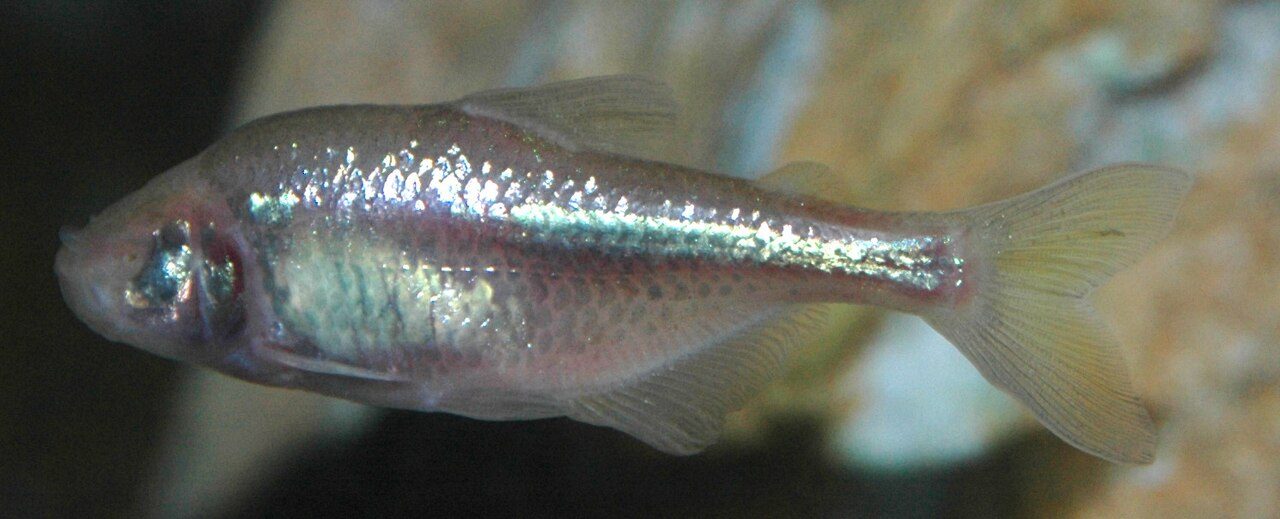
This has resulted in Anophthalmia (the total absence of eyes) and Albinism, giving them their iconic pinkish-white, translucent appearance.
The Cave Environment
Their natural habitat consists of subterranean aquifers and complex Karst topography, where water has carved out limestone caves.
Because these environments are isolated, the fish have developed troglomorphism, a set of physical adaptations specifically for life in caves.
In my experience, replicating this “cave feel” in the aquarium makes the fish feel secure and also creates a eye-catching, high-contrast aesthetic.
Anatomy and the Sixth Sense
You might wonder how a fish with no eyes manages to find food or avoid crashing into the glass.
The mexican tetra blind cave fish relies on an incredibly advanced lateral line system that is far more sensitive than that of their surface-dwelling cousins.
This system uses neuromasts, which are tiny sensory organs that detect minute changes in water pressure and vibrations.
Spatial Mapping
I’ve noticed that when you first introduce these fish to a new tank, they may seem a bit frantic as they “map” their surroundings.
Within an hour, they will have memorized the layout of every rock and plant, swimming at full speed without ever touching an object.
It is a remarkable display of biological engineering that proves sight isn’t the only way to perceive the world.
Pro Tip: When cleaning the tank or rearranging decor, try to keep the main rock structures in the same place. While they can re-map quickly, sudden changes to their environment can cause temporary stress as they recalibrate their internal navigation.
Ideal Tank Setup and Design
Setting up a tank for the mexican tetra blind cave fish is an exercise in creativity, as you don’t need to worry about high-intensity lighting for the fish’s sake.
While they are quite hardy, providing a 20 to 30-gallon tank is ideal to allow them plenty of room for their active swimming style.
Unlike some different kinds of tetra fish that prefer heavily planted tanks, these cave dwellers look best in “hardscape” focused setups.
Substrate and Decor
I recommend using a dark substrate, such as black sand or fine gravel, to make their pale bodies “pop” visually.
Smooth river stones, slate, and driftwood can be used to create crevices and overhangs that mimic their natural limestone caves.
Avoid using decorations with sharp or jagged edges, as their fast-paced swimming could lead to accidental scrapes if they are startled.
Lighting Requirements
Since they live in total darkness in the wild, they are sensitive to sudden, bright lights.
I prefer using dimmable LED lighting or even “moonlight” blue settings to create a subterranean ambiance.
If you want to keep plants, choose low-light species like Anubias or Java Fern that can stay healthy in the shaded areas of the tank.
Water Parameters and Chemistry
The mexican tetra blind cave fish is remarkably adaptable, but they do have specific preferences regarding water hardness.
Coming from limestone caves, they are accustomed to water with high carbonate hardness and a stable pH.
Below is a table of the ideal parameters I have found to be most successful for long-term health:
| Parameter | Ideal Range |
|---|---|
| Temperature | 68°F – 77°F (20°C – 25°C) |
| pH Level | 7.0 – 8.5 |
| Water Hardness (GH) | 10 – 25 dGH |
| Ammonia / Nitrite | 0 ppm |
| Nitrate | < 20 ppm |
Regular water changes are essential, as these fish have a high metabolism and produce a fair amount of waste for their size.
I usually aim for a 25% water change every week to keep the nitrates low and the minerals replenished.
Diet and Nutrition for Eyeless Tetras
Feeding a blind fish might seem like a challenge, but I can assure you that these fish are often the first to find the food.
Their sense of smell and their ability to detect the “vibration” of falling food particles make them excellent scavengers.
They are opportunistic omnivores and will eat almost anything you provide.
Recommended Foods
I have found that a varied diet is the key to maintaining their shimmering white scales and high energy levels.
Using a high-quality sinking pellet or flake is a great base, but they settle in when given frozen or live treats.
Bloodworms, brine shrimp, and daphnia are favorites that trigger their natural hunting instincts.
For the best results, you should look for the best fish food for tetras to make sure they get the vitamins they need.
Feeding Behavior
When you drop food into the tank, you will see the school begin to zip around in a circular pattern.
This is their way of “sweeping” the water column to locate the particles.
They are quite enthusiastic eaters, so be careful not to overfeed, as they will keep eating as long as food is present.
While the mexican tetra blind cave fish is generally peaceful, they are very active and can be a bit “boisterous” for shy species.
They are schooling fish by nature and should always be kept in groups of at least six individuals.
In a group, they feel more secure and exhibit more natural, playful behaviors.
Compatible Companions
Because they flourish in harder water, they make great tank mates for other solid species.
I have successfully kept them with various livebearers, larger rasboras, and even some medium-sized catfish.
They can also be housed with a hardy and active species like the Buenos Aires tetra, provided the tank is large enough.
Common Mistake: Avoid keeping them with very slow-moving fish with long fins, like fancy guppies or bettas. Because the cave fish are blind, they may accidentally “bump” or nip at trailing fins while searching for food.
Breeding the Mexican Tetra Blind Cave Fish
Breeding these fish is a rewarding experience and is surprisingly straightforward for intermediate keepers.
They are egg-scatterers, meaning they will release their eggs among plants or substrate without providing parental care.
To trigger spawning, I recommend slightly increasing the temperature and providing plenty of live foods for a week.
Raising the Fry
Once the eggs are laid, it is best to remove the adult fish, as they will not hesitate to eat their own offspring.
The fry will hatch in about 24 to 48 hours and will be free-swimming shortly after.
Interestingly, the fry are actually born with small, functional eyes that eventually skin over and disappear as they mature.
This is a interesting glimpse into their evolutionary history and a reminder of their surface-dwelling ancestors.
Health and Longevity
In a well-maintained aquarium, these fish can live for 5 to 7 years, sometimes even longer.
They are generally resistant to many common diseases, but they can still fall victim to Ich or fungal infections if water quality slides.
Because they lack pigment, any redness or inflammation on their skin is very easy to spot, allowing for quick treatment.
Always quarantine new additions to the tank to prevent the introduction of parasites to your established school.
Questions and answers
Do blind cave fish feel pain if they bump into things? No, they rarely “bump” into things with enough force to cause pain. Their lateral line system acts like a protective cushion of sensory data that prevents hard collisions.
Can I keep them in a community tank with light? Yes, they adapt well to standard aquarium lighting. However, they will be much more active and comfortable if you provide plenty of shaded areas and caves.
Why is my blind cave fish turning slightly yellow or pink? Their color can be influenced by their diet. Foods high in carotenoids can give them a slight pinkish or yellowish hue, which is perfectly normal and healthy.
Do they need a heater? Yes, while they can tolerate cooler temperatures than some tropical fish, they are most active and healthy when kept in the mid-70s Fahrenheit.
Are they aggressive toward other fish? They are not aggressive in a predatory sense, but their constant movement and “bumping” can stress out very calm or sedentary tank mates.
Where that leaves you
The mexican tetra blind cave fish is proof of the incredible resilience of life.
Keeping them has taught me to appreciate the “invisible” side of the hobby—the water currents, the vibrations, and the chemistry that we often overlook.
If you provide them with a hard-water environment, plenty of swimming space, and a varied diet, you can enjoy these unique creatures for many years.
- 2003First tank
- 20+Years keeping
- 40+Tanks kept
- 0Sponsored picks
Howard set up his first 10-gallon planted tank in 2003 and lost half of it within six weeks. Two decades and more than forty aquariums later, he writes the guides he wished he had then: clear numbers, the reasons behind them, and what actually goes wrong in home tanks.