Are Angelfish Aggressive? The Complete Guide To Managing Cichlid
Yes, angelfish are semi-aggressive cichlids that exhibit territoriality, hierarchical dominance, and breeding aggression. While often peaceful, they can become predatory toward smaller fish and combative with their own kind as they mature.
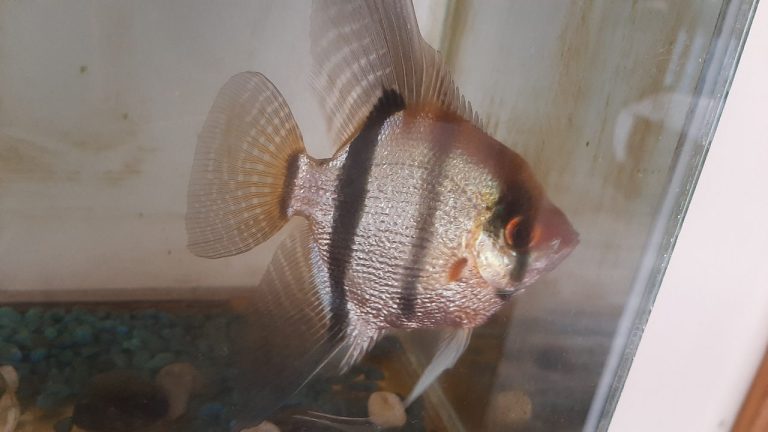
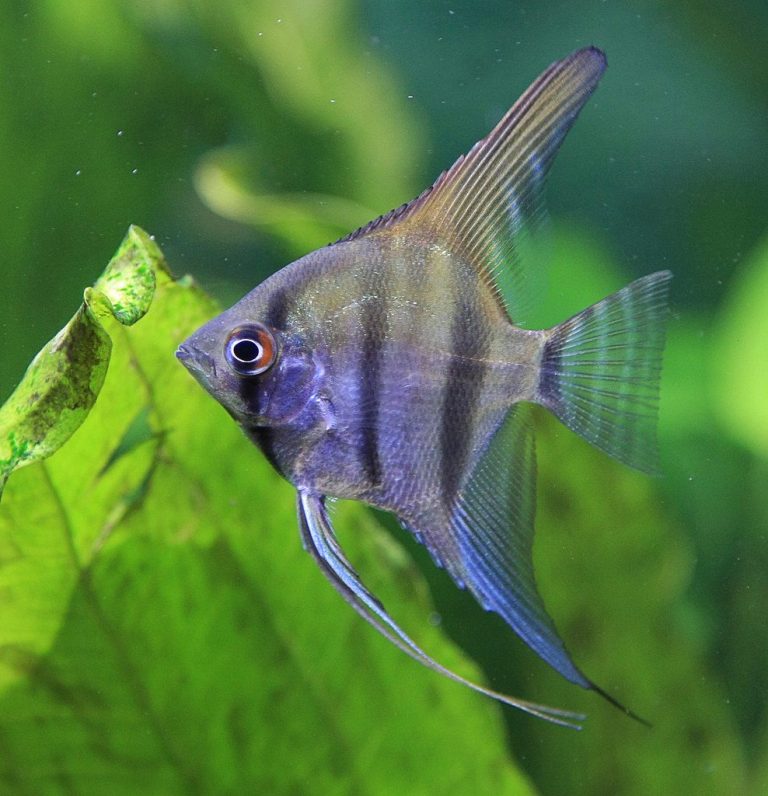
Many new hobbyists are drawn to the elegant, disc-shaped beauty of the freshwater angelfish. Their flowing fins and majestic swimming patterns often earn them a centerpiece spot in home aquaria.
However, many owners soon find themselves asking: are angelfish aggressive? It is a common point of confusion because their graceful appearance often masks a complex, territorial nature.
In my experience of keeping these fish for over a decade, I have learned that “aggressive” is a relative term. Understanding their biological drives is the first step toward a peaceful community tank.
These fish are members of the Pterophyllum scalare species, and they belong to the wider cichlid family. This lineage is famous for intelligence, parental care, and, most notably, a spirited temperament.
At a glance: Freshwater angelfish (Pterophyllum scalare)
- Temperature
- 76–84°F (24–29°C)
- Water pH
- 6.0–7.5
- Adult size
- 6 in long, 8 in tall (15 × 20 cm)
- Minimum tank
- 30 gal for a pair, 55 gal tall for a group
- Group size
- Pair or group of 5+
- Temperament
- Semi-aggressive, territorial when breeding
- Diet
- Omnivore: pellets, flakes, frozen bloodworm and brine shrimp
- Lifespan
- 10–12 years
Keeper’s tip: Choose a tall tank; height matters more than length for a fish that grows taller than it is long.
The Biological Roots of Angelfish Temperament
To answer the question of whether these fish are mean, we have to look at their wild origins. They hail from the slow-moving waters of the Amazon River basin, where competition for resources is high.
In the wild, Pterophyllum scalare must defend their space to survive and successfully raise their young. This genetic hardwiring does not disappear just because they are in a glass box in your living room.
As they grow from juveniles into adults, their social structure changes significantly. What was once a group of playful youngsters can quickly turn into a battlefield for hierarchical dominance.
Understanding Hierarchical Dominance
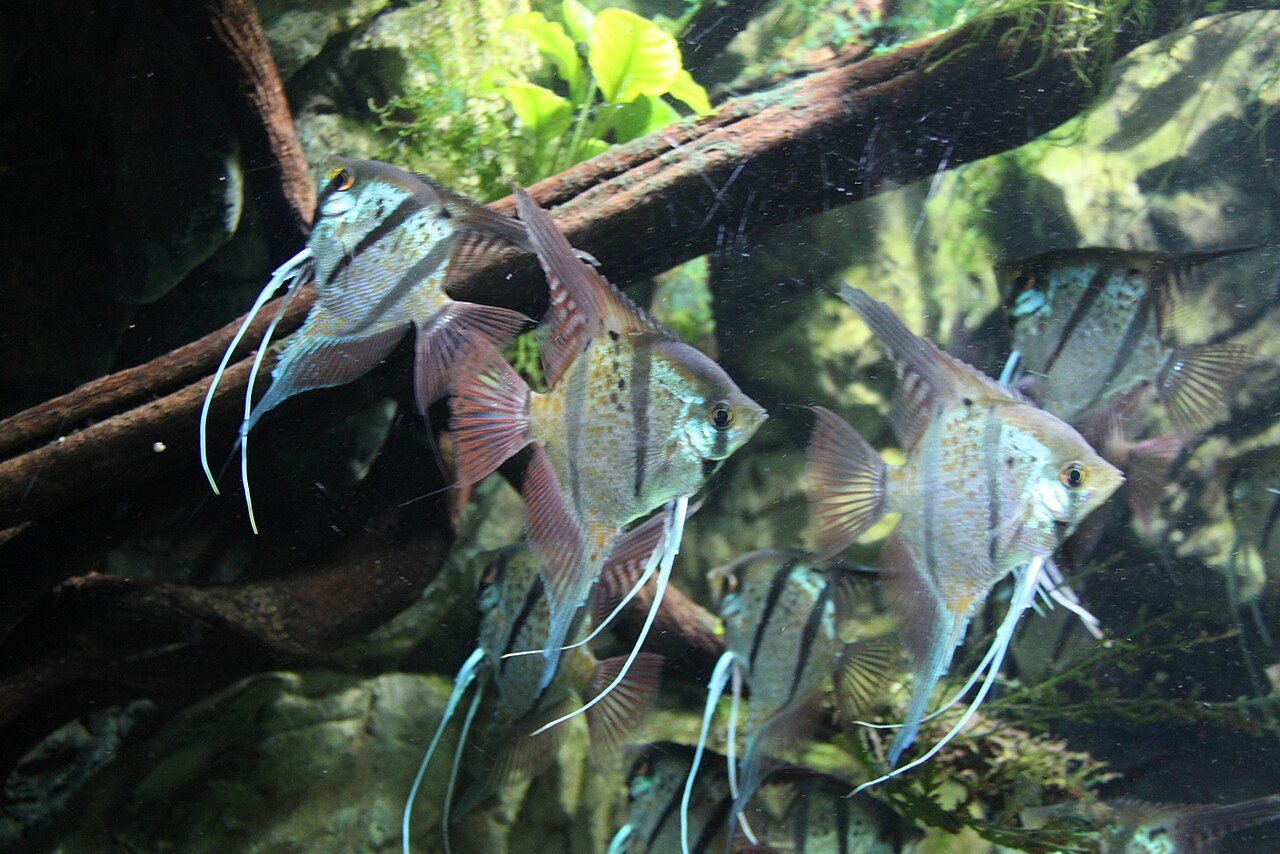
In a group of angelfish, there is almost always a “boss” or an alpha. This individual will assert its authority by chasing others away from the best feeding spots or prime real estate in the tank.
This behavior is known as conspecific aggression, which means aggression directed toward members of the same species. It is their way of establishing a stable pecking order within the group.
If you notice your fish constantly nudging or chasing one another, they are likely trying to figure out who sits at the top of the social ladder. This is a natural part of their development.
The Phenomenon of Lip-Locking
One of the most dramatic displays of aggression is lip-locking. This occurs when two fish grab each other by the mouth and pull or push with significant force.
While it looks like they are kissing, it is actually a test of strength. They are measuring each other’s power to see who should back down in a territorial dispute.
If lip-locking persists for a long time, it can lead to damaged mouths or secondary infections. In my years of keeping them, I have found that providing more space usually resolves these physical duels.
Pro Tip: The Power of Visual Barriers
When I first started keeping larger groups, I noticed that aggression dropped significantly when I added tall pieces of driftwood and dense plants. By creating visual barriers, you allow a bullied fish to escape the line of sight of the dominant alpha, which instantly lowers the stress levels in the tank.
are angelfish aggressive? Identifying the Primary Triggers
There are several specific scenarios that will turn a normally calm angelfish into a territorial warrior. Identifying these triggers allows you to intervene before any fish are harmed.
The most common causes of aggression include overcrowding, lack of food, and the onset of the breeding cycle. When these factors align, even the most “angelic” fish can become a bully.
Territoriality and Spawning Site Defense
The most intense aggression occurs when a pair decides to spawn. As substrate spawners, they will pick a flat surface, such as a large leaf or a piece of slate, to lay their eggs.
Once the eggs are laid, the pair will engage in fierce spawning site defense. They will attack any fish, regardless of size, that ventures too close to their future fry.
During this time, the parents become incredibly protective. They will flare their fins and dart at intruders to ensure the safety of their clutch.
The Role of the Genital Papilla in Identifying Pairs
It is often difficult to tell males from females until they are ready to breed. When they are in the mood, you will see a small tube, known as the genital papilla, emerge near the anal fin.
The female’s papilla is blunt and wide, while the male’s is pointed and narrow. Once you see these appearing, expect the aggression levels in your tank to spike as they claim their territory.
If you are interested in successfully forming breeding pairs, check out our guide on forming breeding pairs. This process requires patience and a keen eye for behavioral changes.
Managing Tank Mates and Predatory Instincts
A common mistake beginners make is assuming that angelfish are “community-friendly” in the same way a guppy is. While they can live with others, they are still predators.
In the wild, a large part of their diet consists of smaller fish and crustaceans. This instinct remains very much alive in the home aquarium.
The Neon Tetra Dilemma
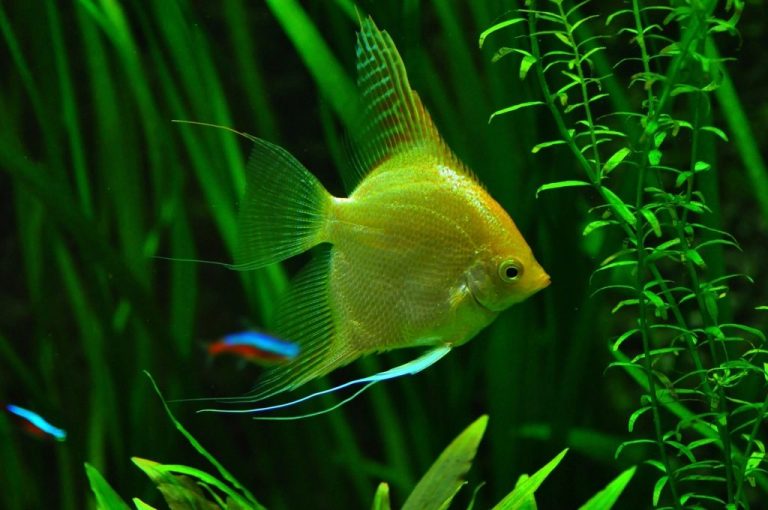
A classic example involves Paracheirodon axelrodi, commonly known as the Cardinal Tetra, or its cousin, the Neon Tetra. While they look beautiful together, a full-grown angelfish can easily swallow a small tetra.
If the fish fits in the angelfish’s mouth, it will eventually be considered a snack. This is not necessarily “aggression” in the emotional sense, but rather a natural feeding response.
To keep a peaceful tank, you must choose tank mates that are too large to be eaten but not so aggressive that they nip at the angelfish’s long, trailing fins.
| Tank Mate Type | Compatibility Level | Reasoning |
|---|---|---|
| Corydoras Catfish | High | Bottom-dwellers that stay out of the angelfish’s mid-water territory. |
| Rummy Nose Tetras | Medium | Fast swimmers that are usually too large to be eaten by sub-adults. |
| Tiger Barbs | Low | Notorious fin-nippers that will stress out and damage angelfish. |
| Dwarf Gouramis | Medium | Can be territorial; requires a large tank with many hiding spots. |
The Importance of Tank Size in Curbing Aggression
One of the most effective ways to reduce aggression is to provide an appropriately sized environment. When fish are cramped, their instinct to defend what little space they have increases tenfold.
A tall tank is better than a long, shallow one. Because of their vertical body shape, they feel more secure when they have plenty of height to move through.
I always recommend at least 30 to 55 gallons for a small group. Anything smaller often leads to constant fighting and stressed-out fish that are prone to disease.
Interestingly, keeping just two angelfish can often be more problematic than keeping six. In a pair, the dominant fish has only one target for its aggression.
In a larger group, the aggression is spread out among multiple individuals. This prevents any single fish from being bullied to the point of exhaustion or death.
However, you must make sure your filtration can handle the biological load of a larger group. Following proper care requirements is essential for maintaining water quality and lowering stress.
Pro Tip: The Rearrangement Strategy
If you have a particularly aggressive individual claiming the whole tank, try removing it for an hour and rearranging the decorations. When you reintroduce the fish, the “territories” are gone, and everyone has to start from scratch. This often resets the social hierarchy and levels the playing field.
How Environmental Factors Influence Behavior
Water chemistry and temperature play a huge role in how your fish act. If the water is too warm, their metabolism speeds up, which can lead to increased activity and irritability.
Poor water quality is another major stressor. High levels of ammonia or nitrate can make fish feel vulnerable, causing them to lash out at their tank mates.
If you keep stable, clean water, you provide a foundation for calm behavior. A healthy fish is a much more predictable and manageable inhabitant than one struggling with its environment.
Feeding Habits and Resource Competition
Hungry fish are angry fish. If you only feed in one corner of the tank, the dominant fish will likely guard that spot, preventing others from eating.
I’ve noticed that spreading food across the entire surface of the water helps. This forces the “alpha” to move around, allowing the more submissive fish to grab a meal in the meantime.
Using high-quality flakes, pellets, and frozen foods helps make sure they are getting the nutrients they need. A well-fed angelfish is much less likely to go hunting for its smaller tank mates.
Reader questions
Can I keep a single angelfish to avoid aggression?
Yes, keeping a single angelfish is a great way to enjoy their beauty without worrying about conspecific fighting. They do not get “lonely” in the human sense and will often be quite peaceful with non-cichlid tank mates.
Why is my angelfish suddenly attacking its mate?
This often happens if a spawn fails or if the pair is young and inexperienced. Stress from outside the tank, like loud noises or heavy foot traffic, can also cause them to turn on each other.
Do different colors of angelfish have different temperaments?
While there is no scientific proof that color affects personality, many hobbyists believe that wild-type (silver) angelfish are slightly more aggressive and hardy than highly inbred color strains like blushing or marble varieties.
How can I stop my angelfish from nipping other fish?
The best solution is to increase the tank size or add more plants. If the nipping is predatory, you must remove the smaller fish immediately, as the angelfish will not stop until it has successfuly hunted them.
Is it normal for angelfish to “shiver” at each other?
Yes, this “shivering” or “twitching” is usually a display of dominance or a part of the courtship ritual. It is a way for the fish to show off their size and health to a potential mate or rival.
Conclusion: Achieving Harmony in the Angelfish Tank
So, are angelfish aggressive? The answer is a nuanced yes, but it is an aggression that can be managed with the right knowledge and setup.
If you respect their cichlid nature, providing ample space, and choosing their companions wisely, you can enjoy these “Kings of the Amazon” without the constant stress of tank warfare.
Every fish has its own personality. Some individuals will be exceptionally mellow, while others will be lifelong bullies.
Observation is your best tool. Spend time watching your tank every day to catch the early signs of lip-locking or excessive chasing.
With some patience and the right environmental tweaks, you can create a flourishing, beautiful aquarium where your angelfish can shine. Keeping these majestic fish is a satisfying experience that teaches every aquarist the value of balance and care.

- 2003First tank
- 20+Years keeping
- 40+Tanks kept
- 0Sponsored picks
Howard set up his first 10-gallon planted tank in 2003 and lost half of it within six weeks. Two decades and more than forty aquariums later, he writes the guides he wished he had then: clear numbers, the reasons behind them, and what actually goes wrong in home tanks.