Penguin Tetra Vs Black Skirt Tetra – Choosing The Best Schooling Fish
The Penguin Tetra is a slim, fast-swimming species known for its unique tilted posture, whereas the Black Skirt Tetra is a hardy, deep-bodied fish better suited for larger, peaceful community tanks.
Selecting the right schooling fish can transform a standard tank into a eye-catching display of synchronized movement.
In my experience of over a decade in the hobby, I have found that the penguin tetra vs black skirt tetra debate often comes down to the specific layout of your aquarium and the activity level you desire.
Both of these species belong to the Characidae family and are staples in the aquarium world, yet they offer completely different aesthetics and behaviors.
Whether you are looking for the sleek, “hockey-stick” look of the Penguin Tetra or the bold, shadowy presence of the Black Skirt Tetra, understanding their nuances is key to a flourishing tank.
Let’s look at the details of these two South American classics to see which one deserves a spot in your home.
At a glance: Black skirt tetra (Gymnocorymbus ternetzi)
- Temperature
- 70–85°F (21–29°C)
- Water pH
- 6.0–7.5
- Adult size
- 2.5 in (6 cm)
- Minimum tank
- 20 gal
- Group size
- Groups of 6+
- Temperament
- Semi-peaceful, may nip fins
- Diet
- Omnivore: flakes, pellets, frozen foods
- Lifespan
- 3–5 years
Keeper’s tip: Keep them in a proper group; singles and pairs are the ones that harass bettas and angelfish.
Penguin Tetra vs Black Skirt Tetra: Physical Characteristics
When you first look at these two fish, the physical differences are striking.
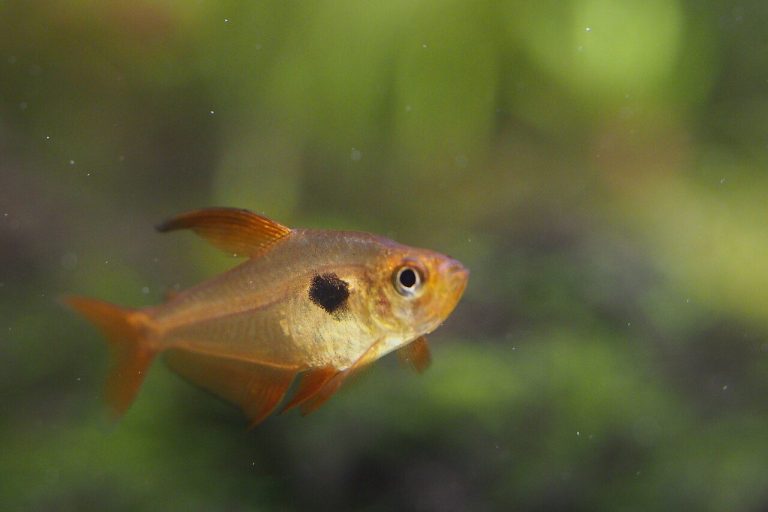
The Penguin Tetra, scientifically known as Thayeria boehlkei, is slender and streamlined, designed for quick bursts of speed in open water.
Its most famous feature is the bold black stripe that runs along its lateral line and extends down into the lower lobe of the caudal fin.
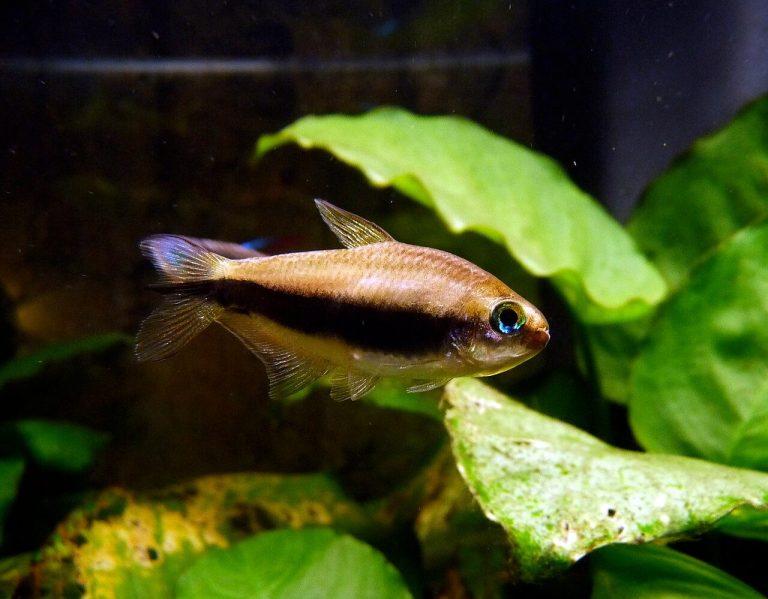
In contrast, the Black Skirt Tetra (Gymnocorymbus ternetzi) has a much deeper, disc-shaped body.
It is characterized by two vertical black bars on its silver body and a large, flowing anal fin that looks like a “skirt,” hence the common name.
| Feature | Penguin Tetra (Thayeria boehlkei) | Black Skirt Tetra (Gymnocorymbus ternetzi) |
|---|---|---|
| Body Shape | Elongated, slender | Deep-bodied, tetragon-shaped |
| Average Size | 2 to 3 inches | 2 to 2.5 inches |
| Primary Colors | Silver with a single black horizontal stripe | Silver/Grey with vertical black bars |
| Swimming Style | Tilted upward at an angle | Horizontal, steady gliding |
One interesting observation I have made over the years is that the Black Skirt Tetra tends to lose some of its deep black coloration as it ages.
Older specimens often take on a more translucent or greyish-charcoal hue, whereas the Penguin Tetra maintains its sharp contrast throughout its life.
If you are just starting out, you might find that some popular starter fish offer more colorful colors, but these two provide a sophisticated, monochromatic look.
Behavior and Shoaling Habits
Both species exhibit classic shoaling behavior, meaning they feel most secure when kept in groups of six or more.
However, the way they interact with their environment and their tank mates differs significantly.
Penguin Tetras are high-energy fish that tend to stay in the upper and middle layers of the water column.
They are famous for their “oblique” swimming style, often resting at a 30-degree upward angle, which makes them look like they are constantly ready to dart away.
Black Skirt Tetras are generally more sedate, though they can become quite assertive during feeding times.
I’ve noticed that in smaller groups, Black Skirts can occasionally become “nippy,” especially toward slow-moving fish with long, flowing fins.
Pro Tip: To minimize aggression in Black Skirt Tetras, always keep them in a group of at least 8 to 10 individuals. This disperses their natural pecking order and prevents any single fish from becoming a bully.
Penguin Tetras are much less likely to nip fins, but their frantic swimming can sometimes stress out extremely shy species.
If you want a peaceful community, the Penguin Tetra is often the “safer” choice for delicate tank mates, while the Black Skirt is better for solid communities.
Water Parameters and Ideal Habitat
Both of these tetras hail from the Amazon River basin, meaning they flourish in soft, slightly acidic water.
In their natural habitat, they are often found in “blackwater” environments where decaying organic matter releases tannins and humic substances into the water.
While they are adaptable to standard tap water conditions, providing them with a more natural setup will bring out their best health and colors.
Using peat filtration or adding dried Indian Almond leaves can help lower the pH and provide the dark, tea-colored water they love.
| Parameter | Ideal Range |
|---|---|
| Temperature | 72°F to 82°F (22°C to 28°C) |
| pH Level | 5.8 to 7.5 (6.5 is ideal) |
| Water Hardness (dGH) | 4 to 12 dGH |
| Ammonia / Nitrite | 0 ppm (Strict) |
Penguin Tetras specifically appreciate a bit of water movement, as they often inhabit flowing streams in the wild.
Black Skirt Tetras, with their larger fin surface area, prefer calmer waters where they don’t have to fight a heavy current to stay in place.
When designing your scape, I recommend plenty of live plants like Amazon Swords or Vallisneria to provide cover and mimic their natural surroundings.
The Importance of dGH and Water Chemistry
Maintaining a stable dGH (degrees of General Hardness) is important for the long-term health of these Characins.
If the water is too hard, you may notice that your fish become more susceptible to skin infections or respiratory stress.
I have often used a mix of RO (Reverse Osmosis) water and dechlorinated tap water to achieve the perfect balance for my tetra tanks.
Tank Setup and Community Compatibility
When considering the penguin tetra vs black skirt tetra for your aquarium, you must look at your existing or planned tank mates.
Penguin Tetras are incredibly fast, making them great companions for other active fish like Zebra Danios or Rasboras.
They also do well with bottom dwellers like Corydoras catfish, as they rarely venture to the substrate.
Black Skirt Tetras are a bit more versatile because of their size and hardiness, but they should be kept away from long-finned fish like Bettas or Guppies.
They are excellent in tanks with larger community fish such as Gouramis or even some of the more peaceful dwarf cichlids.
Pro Tip: If you notice your Penguin Tetras jumping near the surface, help you have a tight-fitting lid. They are notorious jumpers, especially when startled during a water change or when the lights first turn on.
For a 20-gallon long aquarium, you could comfortably house a school of 8 to 10 of either species.
However, if you choose Black Skirt Tetras, the extra vertical space of a “high” tank is often appreciated due to their deep body shape.
If you ever notice your fish acting lethargic or hiding, it is vital to check for identifying fish stress before the situation escalates.
Diet and Nutritional Requirements
In the wild, both species are omnivorous, feeding on small insects, crustaceans, and plant matter.
In the home aquarium, they are not picky eaters and will readily accept high-quality flakes and pellets.
To see them settle in and display colorful colors, I always suggest a varied diet including frozen or live foods.
Bloodworms, brine shrimp, and daphnia are excellent choices that provide the protein needed for growth and energy.
Feeding small amounts twice a day is better than one large feeding, as it keeps their metabolism steady and reduces waste in the water.
I’ve found that Penguin Tetras are particularly fun to watch during feeding, as they will “hunt” floating flakes with incredible precision and speed.
Common Health Issues and Prevention
Like most tropical fish, both Penguin and Black Skirt Tetras are susceptible to Ichthyophthirius multifiliis, more commonly known as Ich or white spot disease.
This parasite often appears when the fish are stressed by poor water quality or sudden temperature fluctuations.
Maintaining a consistent environment is the best way to prevent outbreaks.
Because these fish are sensitive to certain medications, especially those containing copper, always read the labels carefully before treating the whole tank.
Quarantining new arrivals for at least two weeks is a practice I have followed for years, and it has saved my main displays from disaster many times.
If you are interested in expanding your collection, you might also look into the black phantom tetra, which shares similar health requirements.
Breeding the Penguin and Black Skirt Tetra
Breeding these tetras can be a satisfying challenge for the intermediate hobbyist.
Both are egg-scatterers, meaning they do not provide any parental care and will actually eat their own eggs if given the chance.
To succeed, you will need a separate breeding tank with soft water, a slightly higher temperature (around 80°F), and plenty of fine-leaved plants or a spawning mop.
After the female appears rounded with eggs and the male shows intense coloration, you should see spawning behavior in the early morning hours.
Once the eggs are laid, the adults must be removed immediately to ensure the survival of the fry.
The fry are tiny and will require infusoria or specialized liquid fry food for the first few days before they can handle baby brine shrimp.
Penguin Tetra vs Black Skirt Tetra: Comparison Summary
Choosing between these two depends on your personal style and the “vibe” of your aquarium.
The Penguin Tetra offers a unique, geometric look and high-speed energy that works perfectly in rectangular, planted tanks.
The Black Skirt Tetra offers a classic, bold silhouette and incredible hardiness, making it a “bulletproof” choice for those who might still be perfecting their water maintenance routine.
In my view, you can’t go wrong with either, provided you respect their need for a school and clean water.
FAQ
Can Penguin Tetras and Black Skirt Tetras live together?
Yes, they can coexist peacefully in a large enough aquarium (30 gallons or more). Make sure both have a full school of their own kind to prevent inter-species stress.
How long do these tetras typically live?
With proper care, both species can live for 3 to 5 years, though some well-maintained Black Skirt Tetras have been known to reach 7 years.
Are Black Skirt Tetras aggressive?
They are generally peaceful but can be “semi-aggressive” fin-nippers if kept in too small a group or in a tank that is too cramped.
Do Penguin Tetras need a heater?
Yes, they are tropical fish and require a consistent temperature between 72°F and 82°F. A high-quality submersible heater is essential.
Why is my Penguin Tetra swimming sideways?
It is likely just their natural “oblique” resting position. However, if they are spiraling or can’t maintain their balance, it could be a swim bladder issue.
Putting it all together
In the penguin tetra vs black skirt tetra comparison, both fish emerge as champions of the freshwater hobby.
The Penguin Tetra brings a sense of dynamic movement and a unique “hockey stick” aesthetic that is hard to find elsewhere.
Meanwhile, the Black Skirt Tetra provides a dependable, hardy, and visually striking presence that has anchored community tanks for decades.
Whichever you choose, keep in mind that the key to their success lies in providing a stable environment, a nutritious diet, and the companionship of their own kind.
By mirroring their natural South American habitats with soft water and plenty of cover, you will enjoy these remarkable Characidae species for years to come.

- 2003First tank
- 20+Years keeping
- 40+Tanks kept
- 0Sponsored picks
Howard set up his first 10-gallon planted tank in 2003 and lost half of it within six weeks. Two decades and more than forty aquariums later, he writes the guides he wished he had then: clear numbers, the reasons behind them, and what actually goes wrong in home tanks.