Blind Cave Tetra Male Vs Female – How to Tell Them Apart
To distinguish a Blind Cave Tetra male vs female, look at the body shape; females are significantly rounder and deeper-bodied, especially when gravid. Males are slimmer, slightly smaller, and possess subtle hooks on their anal fins.
Understanding the subtle differences between a Blind Cave Tetra male vs female is one of the most satisfying challenges for an intermediate aquarist. These remarkable fish, scientifically known as Astyanax mexicanus, have evolved in total darkness, losing their eyes and pigmentation over millennia.
In my experience of over a decade maintaining specialized characin setups, I have found that while they lack the bright colors of a Neon Tetra, their unique biology makes them a centerpiece of any conversation. Identifying their sex is the first step toward witnessing their unique spawning behavior.
Whether you are looking to start a breeding project or simply want a balanced school, this guide will provide the technical depth and practical experience you need. We will go through the morphology, biology, and environmental triggers required to master the care of these subterranean wonders.
At a glance: Blind cave tetra (Astyanax mexicanus)
- Temperature
- 68–77°F (20–25°C)
- Water pH
- 6.5–8.0
- Adult size
- 3.5 in (9 cm)
- Minimum tank
- 30 gal
- Group size
- Groups of 4+
- Temperament
- Peaceful to semi-aggressive
- Diet
- Omnivore: sinking pellets, flakes, frozen foods
- Lifespan
- 10–15 years
Keeper’s tip: They find food by smell and lateral line, so sinking foods spread across the floor work best.
Identifying Blind Cave Tetra Male vs Female Differences
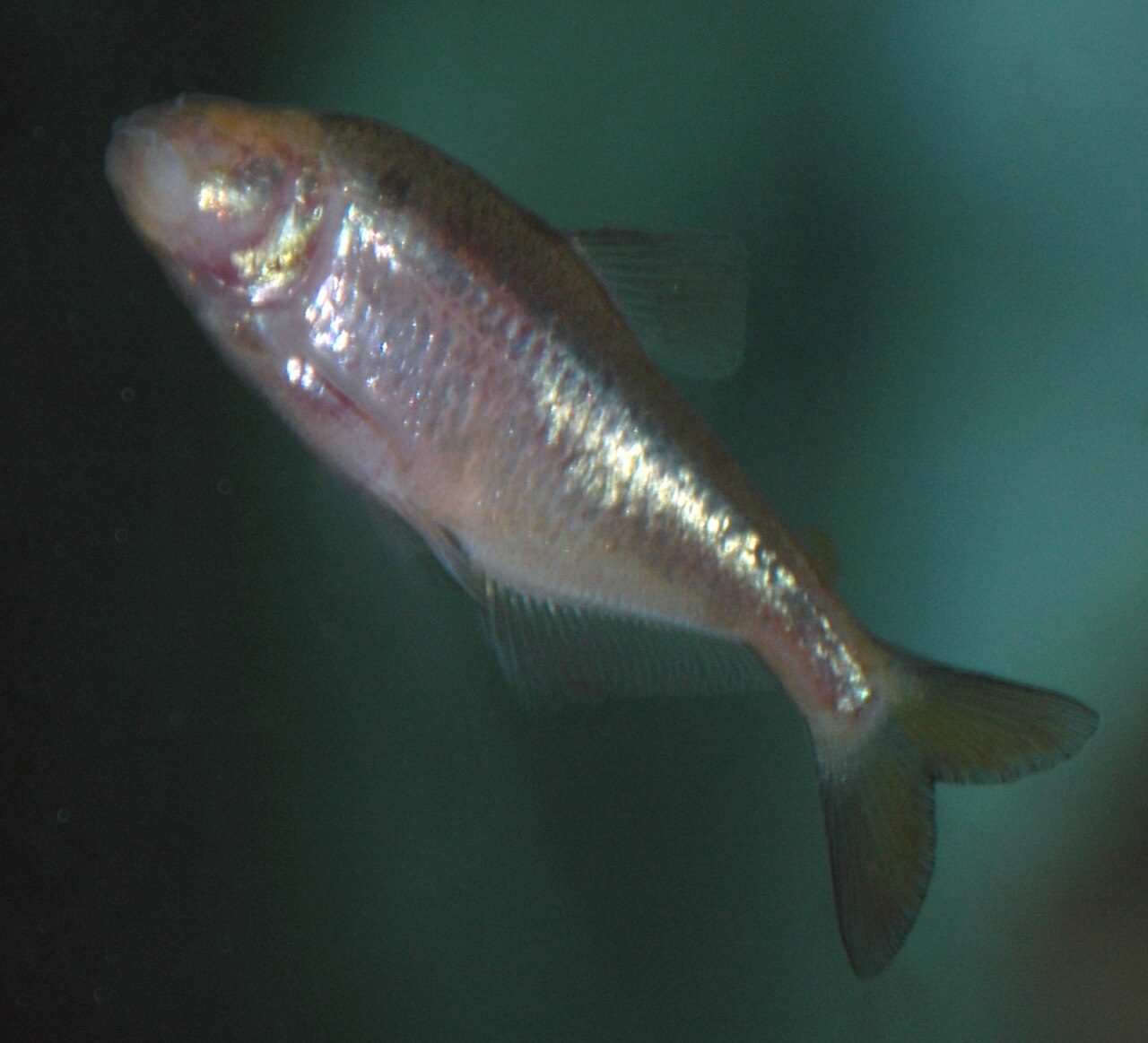
At first glance, a school of Blind Cave Tetras might look like a group of identical, pinkish-white clones. Because they lack eyes and distinct color patterns, you cannot rely on the usual visual cues found in other freshwater tetra fish.
Sexual dimorphism in this species is subtle but consistent once you know where to look. The primary indicators are body depth, overall size, and the specific shape of the fins.
Body Shape and Size
The most reliable way to tell them apart is by observing their profile. Females tend to be much more strong and “tall” when viewed from the side.
A gravid female—one carrying eggs—will have a noticeably distended abdomen, giving her a more rounded appearance compared to the streamlined male. Males maintain a more classic fusiform body shape, which is built for agility and speed within the tight crevices of a cave system.
Anal Fin Morphology
If you look closely, ideally with a magnifying glass or a high-resolution photo, you can see differences in the fins. The male’s anal fin often has tiny, microscopic hooks that help him stay close to the female during the spawning process.
| Feature | Male Blind Cave Tetra | Female Blind Cave Tetra |
|---|---|---|
| Body Profile | Slim, streamlined, and more linear. | Rounder, deeper, and thicker belly. |
| Overall Size | Generally smaller (approx 3 inches). | Slightly larger and heavier (up to 3.5 inches). |
| Anal Fin | May possess tiny hooks; slightly more pointed. | Smooth edge; more rounded appearance. |
| Behavior | More active during “chase” sequences. | Often leads the school or stays in the center. |
Pro Tip: To accurately sex your tetras, try viewing them from directly above the tank. The difference in width between a slim male and a wide, egg-carrying female is much easier to spot from a “bird’s eye” perspective than from the side.
The Biology of the Blind Cave Tetra
To understand a Blind Cave Tetra male vs female, we must look at where they come from. These fish originate from the karst topography of Mexico, specifically within deep subterranean aquifers.
Their environment is characterized by stable temperatures, high mineral content, and a complete lack of light. This has led to a troglomorphic adaptation, where the fish have traded their sight for a highly sensitive lateral line system.
The Power of Neuromasts
Instead of eyes, these tetras use neuromasts—sensory organs located along their head and body. These allow them to detect minute changes in water pressure and vibration.
In my experience, this makes them incredibly efficient at finding food and working through complex hardscapes. During breeding, these sensors allow the male to track the female’s movements with startling precision, even in pitch-black conditions.
Evolutionary Divergence
It is important to note that Astyanax mexicanus actually exists in two forms: the surface-dwelling version with eyes and the cave-dwelling version without. When we discuss sexing these fish, we are almost always referring to the eyeless cave morph common in the hobby.
Interestingly, the cave form has a slower metabolism than its surface cousins. This allows them to survive in nutrient-poor environments, which is something you should consider when planning their diet for conditioning.
Preparing for Breeding: Conditioning the Pair
Once you have identified your Blind Cave Tetra male vs female pairs, you need to prepare them for spawning. This process, known as conditioning, involves providing high-quality nutrition and mimicking natural environmental shifts.
In the wild, spawning is often triggered by seasonal rains that change the water chemistry in their caves. In the aquarium, we can replicate this to encourage the female to become gravid.
High-Protein Dietary Needs
To get the females ready, I recommend a diet rich in live or frozen foods. Bloodworms, daphnia, and brine shrimp are excellent choices that provide the lipids necessary for egg production.
Feeding 2-3 times a day in small amounts is better than one large feeding. This mimics the occasional “flushes” of nutrients they might receive in their natural subterranean aquifer.
Water Parameters and Specific Conductivity
Blind Cave Tetras prefer harder water with a higher specific conductivity than many other tetras. They flourish in environments where the mineral content is stable, reflecting the limestone caves of their origin.
| Parameter | Ideal Range for Breeding |
|---|---|
| Temperature | 68°F – 77°F (20°C – 25°C) |
| pH | 7.0 – 8.0 |
| Hardness (GH) | 10 – 20 dGH |
| Water Change | 20% weekly with slightly cooler water |
Common Mistake: Many hobbyists treat Blind Cave Tetras like soft-water Amazonian species. If your water is too soft or acidic, the eggs may fail to develop properly. Always aim for a neutral to slightly alkaline pH for the best results.
Tank Setup for a Successful Cave Colony
Setting up a tank for Blind Cave Tetras is different from designing a lushly planted community aquarium. Since they cannot see, the layout should focus on tactile safety and flow.
I’ve noticed that these fish are much more confident when they have plenty of “walls” to handle by. Using smooth slate, round river stones, or specialized cave decor helps them establish a sense of territory.
Lighting and Aesthetics
While the fish are blind, you likely want to see them. However, keeping the lighting dim or using “moonlight” LEDs can create a more naturalistic feel for a cave-themed tank.
They do not require plants, and in fact, heavy planting can sometimes interfere with their swimming paths. If you want greenery, stick to hardy species like Anubias or Java Fern attached to rocks.
Filtration and Water Flow
A moderate flow is beneficial, as it helps the fish use their neuromasts to “see” the boundaries of the tank. A simple sponge filter or a hang-on-back filter with a baffled output works perfectly.
Make sure there are no sharp edges on your intake pipes. Because they work through by touch, they can occasionally bump into equipment if they are startled or during high-energy spawning runs.
The Spawning Process: Step-by-Step
When your Blind Cave Tetra male vs female pair is ready, the male will begin to drive the female toward a chosen spawning site. This usually happens in the early morning or shortly after a water change.
They are egg-scatterers, meaning they do not provide parental care. In fact, they will eagerly eat their own eggs if given the chance, much like other hardy active species in the tetra family.
Step 1: The Spawning Tank
Set up a separate 10-gallon tank with a mesh bottom or a layer of large marbles. This allows the eggs to fall through the gaps where the adults cannot reach them.
The water should be slightly shallower than the main tank, perhaps 6-8 inches deep. This increases the frequency of “encounters” between the male and female.
Step 2: The Temperature Drop
In my experience, a sudden 2-3 degree drop in temperature via a water change is the most effective trigger. This mimics the cool rainwater entering the subterranean aquifer.
Introduce the pair in the evening. If they are well-conditioned, you will likely find eggs at the bottom of the tank the following morning.
Step 3: Removing the Parents
Once the eggs are laid, remove the adults immediately. The eggs are tiny, translucent, and will hatch in about 24 to 48 hours depending on the temperature.
Step 4: Raising the Fry
The fry will survive on their yolk sacs for the first few days. Once they are free-swimming, they require microscopic foods like infusoria or liquid fry food.
As they grow, you can transition them to baby brine shrimp. Interestingly, the fry are born with eyes. It is only as they mature that the skin grows over the sockets and the eyes degenerate.
Common Pitfalls and How to Avoid Them
Even for experienced keepers, working with Astyanax mexicanus can present challenges. One of the most common issues is failing to recognize when a female is egg-bound versus simply well-fed.
If a female remains extremely large for weeks without spawning, she may be egg-bound. Increasing the water temperature slightly and then performing a large, cool water change can often help “reset” her cycle.
Aggression and Nipping
Despite being blind, these tetras can be surprisingly “nippy.” This is often a result of them trying to identify objects or tank mates in their environment.
Keeping them in a larger school (at least 6-8 individuals) helps distribute any semi-aggressive behavior. If you notice a particular Blind Cave Tetra male vs female being bullied, check your water parameters first, as stress often leads to increased aggression.
The Danger of Overfeeding
Because they have a slower metabolism, it is very easy to overfeed these fish. Obesity can lead to reproductive failure and a shortened lifespan.
I always recommend a “fasting day” once a week. This allows their digestive systems to clear and keeps the males lean and active for breeding attempts.
Common questions
How can I tell if my Blind Cave Tetra is pregnant?
Tetras do not get “pregnant” in the traditional sense; they become “gravid,” which means they are carrying eggs. You will notice the female’s belly area becoming significantly wider and more rounded than usual.
Can I keep Blind Cave Tetras with other fish?
Yes, but with caution. They do well with other beginner-friendly tetras that are large enough not to be eaten. Avoid very slow-moving fish with long fins, as the tetras may nip at them while working through.
Do they need special food because they are blind?
No, they have an incredible sense of smell and can detect vibrations. They will find flake, pellet, or frozen food almost as fast as a fish with eyes.
Why are my Blind Cave Tetras chasing each other?
This is usually either spawning behavior or the establishment of a pecking order. If you see a slimmer male following a rounder female closely, it is likely a breeding attempt.
At what age can you tell the sex of a Blind Cave Tetra?
Usually, once they reach about 1.5 to 2 inches in length, their body shapes become distinct enough to differentiate between males and females.
A last word
Mastering the identification of a Blind Cave Tetra male vs female is a gateway into the interesting world of cave-dwelling organisms. If you focus on the fusiform body shape of the males and the deep, rounded bellies of the gravid females, you can successfully manage your school and even attempt breeding.
These fish are a sign of the incredible power of evolution. Their reliance on neuromasts and their ability to stay healthy in the subterranean aquifers of the karst topography make them one of the most unique additions to the hobby.
In my years of fishkeeping, few things are as satisfying as watching a “blind” fish work through its world with more precision than its sighted counterparts. Provide them with the right minerals, high-quality proteins, and a structured environment, and they will reward you with years of active, intriguing behavior.
, and I hope your journey with these eyeless wonders is as enlightening as mine has been.

- 2003First tank
- 20+Years keeping
- 40+Tanks kept
- 0Sponsored picks
Howard set up his first 10-gallon planted tank in 2003 and lost half of it within six weeks. Two decades and more than forty aquariums later, he writes the guides he wished he had then: clear numbers, the reasons behind them, and what actually goes wrong in home tanks.