How To Tell The Age Of A Sulcata Tortoise – A Practical Guide
You can estimate the age of a Sulcata tortoise by counting the growth rings on their scutes, though this becomes less accurate as the tortoise matures and the shell undergoes natural wear.
At a glance: Sulcata tortoise (Centrochelys sulcata)
- Temperature
- Basking 95–100°F (35–38°C)
- Adult size
- 24–30 in shell (60–76 cm)
- Enclosure
- Outdoor pen for adults
- Group size
- Alone
- Temperament
- Docile, strong diggers
- Diet
- Herbivore: grasses, hay, weeds, low-sugar greens
- Lifespan
- 70+ years
Keeper’s tip: Adults outgrow any indoor enclosure; plan for a secure outdoor pen early.
Many aquarium enthusiasts often find themselves expanding their passion for exotic pets into reptiles. Just as we monitor water chemistry for our aquatic friends, maintaining the health of a Centrochelys sulcata requires a keen eye for physical development.
Whether you are looking to adopt or simply curious about your current companion, knowing how to tell the age of a sulcata tortoise is a common question. While it is rarely an exact science, several biological indicators provide a reliable window into their life stage.
Understanding the Basics of Scute Annuli
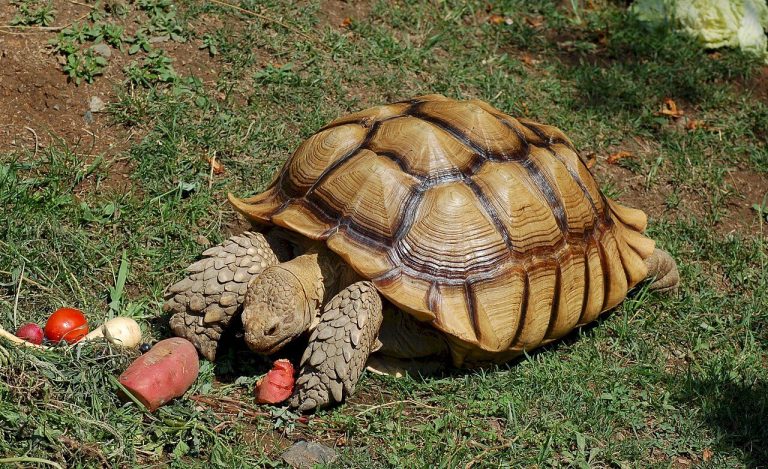
The most common method for estimating age involves looking at the shell, specifically the scutes. These individual, hardened plates are made of keratin.
As a young tortoise grows, it adds new layers of keratin to each scute. These growth rings are often referred to as scute annuli.
In the first few years of life, these rings are usually quite distinct. You can count them much like the rings on a tree trunk to get a rough estimate of the tortoise’s age.
Pro Tip: Do not rely solely on ring counting for older tortoises. As a tortoise ages, the outer layers of the shell naturally erode or become smoothed out due to environmental contact, making the rings difficult or impossible to distinguish.
Analyzing Carapace Morphometrics and Size
While size is not a perfect indicator, it does offer a general guideline for younger specimens. Genetics, diet, and environment play massive roles in how quickly a Sulcata grows.
If you are accustomed to measuring the growth rates of fish, you know that environmental conditions dictate development. Similarly, a tortoise kept in a high-quality enclosure with proper nutrition will grow faster than one kept in poor conditions.
| Estimated Age | Typical Shell Length (Carapace) |
|---|---|
| Hatchling | 2 to 3 inches |
| 1–2 Years | 4 to 6 inches |
| 5 Years | 10 to 14 inches |
| 10+ Years | 16+ inches (Growth slows) |
Biological Indicators of Maturity
As a Sulcata approaches sexual maturity, physical changes occur that have nothing to do with simple ring counting. This is where plastron concavity becomes a key identifier.
In males, the plastron (the bottom of the shell) begins to curve inward. This concave shape is a biological adaptation that allows the male to mount the female during breeding.
Additionally, you should look at gular scute development. These are the horn-like projections extending from the front of the plastron. In older males, these become significantly longer and more pronounced.
Environmental Factors and Health
In my experience, observing the overall condition of the shell is just as important as measuring it. Poor husbandry can lead to pyramiding, where the scutes grow upward in a steep, pointed fashion.
This condition is often a result of improper humidity or a lack of adequate UVB irradiance during the tortoise’s formative years. When evaluating the age of a rescue tortoise, realize that a stunted or deformed shell might make them appear younger or older than they actually are.
Common Mistake: Many beginners assume that a smooth, flat shell is a sign of youth. In reality, a very smooth, worn shell often indicates a senior tortoise that has experienced years of natural abrasion.
The Role of Sclerochronology
For those interested in the science behind the growth, sclerochronology is the study of physical growth patterns in hard tissues. While usually applied to marine biology, the principle holds for our terrestrial friends.
If you have a tortoise with a history of metabolic bone disease, its growth pattern will be permanently altered. This makes age estimation through physical measurement nearly impossible. Always document the history of your reptile if you want to track its long-term development accurately.
FAQ
Can I use a vet to determine my tortoise’s age? A veterinarian can provide a much more accurate estimate by examining the overall skeletal development and wear patterns. They are the best resource if you suspect your tortoise has health issues.
Does diet affect how I tell the age of a sulcata tortoise? Yes, a high-protein diet can lead to rapid, unnatural growth. This can make a young tortoise seem larger than its actual age, leading to misidentification.
How does humidity impact shell health? Proper hygrometry is essential. If the environment is too dry, the keratinization of the scutes can become brittle, leading to excessive flaking that obscures the growth rings.
Putting it all together
Learning how to tell the age of a sulcata tortoise is a satisfying part of being a responsible keeper. While you might not get a definitive birth date without documentation, you can gain a deep understanding of your tortoise’s life stage through careful observation.
Take the time to monitor their growth, shell texture, and physical development. Your dedication to their environment will make sure they live a long, healthy life, just as you strive to do for your fish and shrimp.

- 2003First tank
- 20+Years keeping
- 40+Tanks kept
- 0Sponsored picks
Howard set up his first 10-gallon planted tank in 2003 and lost half of it within six weeks. Two decades and more than forty aquariums later, he writes the guides he wished he had then: clear numbers, the reasons behind them, and what actually goes wrong in home tanks.