CO2 Reactor Vs Atomizer – Which Is Best For Your Planted Aquarium?
The choice between a CO2 reactor vs atomizer primarily hinges on dissolution efficiency, aesthetic preference, and tank size. Atomizers produce fine mist visible in the aquarium, ideal for smaller tanks or those prioritizing cost, while reactors offer near-100% dissolution with no visible bubbles, best for larger, high-tech setups where efficiency and aesthetics are the top priority.
Welcome, fellow aquarists, to “Successful Aquarium”. If you’re serious about growing well-grown, vivid aquatic plants, you’ve likely delved into supplemental CO2 injection. It’s a big help for plant growth, transforming a struggling green patch into a flourishing underwater jungle. But once you commit to CO2, a important decision arises: how do you get that CO2 into your water efficiently?
This is where the debate of a CO2 reactor vs atomizer comes into play. Both devices are designed to dissolve gaseous carbon dioxide into your aquarium water, making it available for your plants. However, they go about it in very different ways, each with its own set of advantages and considerations. Having personally experimented with countless setups over my decade-plus in the hobby, I’ve seen firsthand what works best in various situations. Let’s look closely at the mechanics, pros, and cons of each, helping you make the most informed decision for your planted tank.
Understanding CO2 Injection for Planted Aquariums
Providing supplemental CO2 is arguably the most significant step you can take to improve your planted aquarium. It’s a fundamental building block for photosynthesis, the process by which plants convert light energy into chemical energy, fueling their growth. Without adequate CO2, even with perfect lighting and nutrients, your plants will struggle.
Why CO2 Matters for Plants
Aquatic plants, just like terrestrial plants, need carbon dioxide to settle in. In a closed aquarium system, ambient CO2 levels are often too low to support demanding plant species like `Hemianthus callitrichoides` or Rotala macrandra. Injecting CO2 ensures a steady, sufficient supply, leading to faster growth, more colorful colors, and sturdy health. This also helps plants outcompete nuisance algae.
The Goal: Efficient Dissolution
The primary challenge with CO2 injection is getting the gas to dissolve effectively into the water. CO2 gas from a cylinder is not readily absorbed by water on its own; it needs a mechanism to break it down into smaller particles, increasing its surface area for absorption. The better the dissolution rate, the less CO2 you waste, and the more stable your tank’s `carbonic acid saturation` becomes. This is where diffusers, atomizers, and reactors come in.
The CO2 Atomizer: Tiny Bubbles, Big Impact
CO2 atomizers have become incredibly popular, especially with their compact design and relatively straightforward installation. They are often the first step many aquarists take beyond basic ceramic diffusers. An atomizer’s goal is to create the smallest possible CO2 bubbles, maximizing surface area for dissolution.
How Atomizers Work
An atomizer functions by forcing CO2 gas through a highly porous ceramic membrane or disc. This membrane typically has a very fine `ceramic membrane porosity`, measured in microns. The high pressure from your CO2 regulator pushes the gas through these microscopic pores, shearing it into incredibly `micron-sized bubbles`. These tiny bubbles then disperse into the water column.
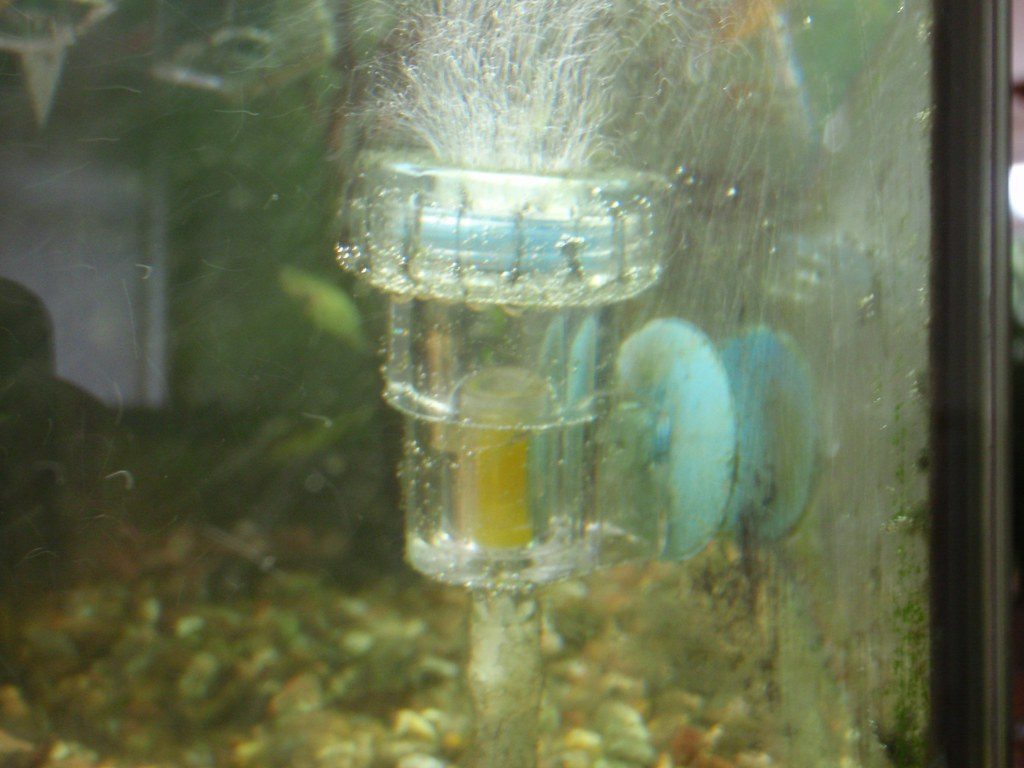
There are two main types: in-tank atomizers and inline atomizers. In-tank atomizers sit directly inside your aquarium, often attached to the glass with suction cups. Inline atomizers, on the other hand, are plumbed directly into your canister filter’s return line, dissolving CO2 within the filter’s tubing before the water re-enters the tank.
Types of Atomizers (In-Tank, Inline)
In-Tank Atomizers: These are the most common and visible type. They typically have a ceramic disc and are placed near a powerhead or filter outflow to help circulate the bubbles throughout the tank. Their main advantage is ease of installation.
Inline Atomizers: These are installed externally on the return hose of a canister filter. They operate on the same principle but dissolve the CO2 before it enters the tank. This makes them virtually invisible, appealing to aquarists who prioritize aesthetics. However, they require cutting your filter tubing for installation.
Pros of CO2 Atomizers
- Cost-Effective: Generally more affordable than reactors, making them a great entry point for those new to CO2.
- Easy Installation (In-Tank): In-tank models are simple to set up, requiring only placement and connection to your CO2 line.
- Good Dissolution for Smaller Tanks: For tanks under 50-60 gallons, a quality atomizer can provide sufficient CO2 dissolution.
- Minimal Impact on Filter Flow: Compared to some reactors, atomizers tend to have less impact on your filter’s flow rate, especially in-tank models. Inline atomizers might cause a slight reduction, but often less than a large inline reactor.
Cons of CO2 Atomizers
- Visible Mist: The most common complaint is the fine mist of bubbles that atomizers produce. While beautiful to some, others find it distracting or cloudy, especially in larger tanks where more CO2 is needed.
- Potential for Clogging: The fine ceramic membrane can clog over time with algae or mineral buildup, reducing efficiency and requiring regular cleaning.
- Lower Efficiency (Compared to Reactors): While good, they rarely achieve 100% dissolution. Some CO2 inevitably escapes the water surface, leading to `CO2 off-gassing` and wasted gas. This means you might need to run higher bubble counts to achieve target CO2 levels.
- Noise: Some atomizers can produce a faint buzzing or hissing sound, especially when new or if the `working pressure PSI` is too high.
Pro Tip: Atomizer Placement for Ideal Dissolution
When using an in-tank atomizer, always place it directly under the outflow of your filter or a small powerhead. This helps make sure the fine CO2 mist is immediately caught by the water current and distributed throughout the entire aquarium, maximizing contact time and preventing localized high CO2 concentrations that could harm fish or shrimp. I’ve noticed a significant difference in plant response and overall CO2 efficiency when bubbles are actively circulated rather than just floating straight up.
The CO2 Reactor: Maximum Dissolution, Minimal Visuals
CO2 reactors represent the pinnacle of CO2 dissolution efficiency. Their design prioritizes ensuring almost every bubble of CO2 dissolves into the water before it leaves the device. This makes them a favorite among high-tech planted tank enthusiasts.
How Reactors Work
A CO2 reactor works by creating a turbulent, high-contact environment where CO2 gas and aquarium water mix thoroughly. Instead of just releasing fine bubbles, reactors actively churn the CO2 within a chamber, breaking it down and forcing it to dissolve completely. Many designs achieve this through various internal baffles, biomedia, or even a `Venturi effect` where water velocity is increased to draw in and shear CO2 bubbles.
The goal is to increase the contact time between the CO2 gas and the water, making sure that by the time the water exits the reactor, the CO2 is fully dissolved. This results in virtually no visible bubbles entering the aquarium.
Types of Reactors (Inline, External, Internal)
Inline Reactors: These are the most popular type of reactor. They are installed externally on the return line of a canister filter, similar to inline atomizers. Water flows into the reactor, mixes with CO2, and then returns to the tank with the CO2 already dissolved. They are completely out of sight.
External Reactors: These are standalone units placed outside the tank, often connected to a dedicated pump or a filter’s outflow. They offer high efficiency and are usually quite large.
Internal Reactors: Less common, these units sit inside the aquarium. They often have an integrated pump to draw water in, mix it with CO2, and then release the dissolved water. They are typically larger and more visually obtrusive than in-tank atomizers but offer higher dissolution.
Pros of CO2 Reactors
- Superior Dissolution Efficiency: Reactors offer near-100% `dissolution rate`, meaning almost no CO2 is wasted. This results in incredibly stable CO2 levels in your water and maximum plant absorption.
- No Visible Bubbles: For those who prefer a pristine, bubble-free aesthetic, reactors are the ideal choice. All the CO2 dissolves before it enters the display tank.
- Consistent CO2 Levels: Due to their high efficiency, reactors can maintain very stable CO2 levels, important for demanding plants and preventing pH swings that can stress fish.
- Ideal for Large Tanks: For tanks 75 gallons and larger, reactors are often the most effective way to deliver sufficient CO2 without needing excessively high bubble counts or multiple diffusers.
Cons of CO2 Reactors
- Higher Initial Cost: Reactors are generally more expensive than atomizers, particularly high-quality inline models.
- Complex Installation (Inline/External): Installing an inline reactor involves cutting filter tubing and often requires careful plumbing. It can be more daunting for beginners. Some might also need an `inline bypass assembly` to allow for easy maintenance without interrupting filter flow.
- Potential for `Head Pressure Loss`: Because water flows through the reactor, it can reduce the flow rate of your canister filter. This can be a concern for filters that are already borderline for your tank size.
- Size: Even inline reactors can be bulky and require space in your aquarium cabinet. Internal reactors are often quite large within the tank itself.
- Maintenance: While less frequent than atomizer cleaning, reactors still require occasional cleaning to prevent buildup that could hinder efficiency or flow.
Common Mistake: Underestimating Head Pressure Loss with Inline Reactors
When I first moved to an inline reactor, I didn’t adequately account for the `head pressure loss` it would cause on my canister filter. The result was noticeably reduced flow in my tank, which impacted filtration and nutrient distribution. Always factor in that an inline reactor will add resistance to your filter’s flow. For right performance, consider using a filter with a higher flow rate than typically recommended for your tank size, or be prepared to use a separate powerhead for circulation. This helps make sure your plants still receive adequate water movement despite the reactor’s impedance.
CO2 Reactor vs Atomizer: A Side-by-Side Comparison
To make an informed decision, let’s directly compare the key aspects of CO2 reactors and atomizers.
| Feature | CO2 Atomizer | CO2 Reactor |
|---|---|---|
| Dissolution Efficiency | Good (80-90%), produces visible mist. Some CO2 off-gassing. | Excellent (95-100%), no visible bubbles. Highly efficient. |
| Aesthetics | In-tank models are visible, producing a fine mist. Inline models are hidden. | Typically hidden (inline/external), resulting in no visual impact within the tank. |
| Installation | Easy (in-tank), moderate (inline – cutting tubing). | Moderate to complex (cutting tubing, plumbing, space consideration). |
| Maintenance | Ceramic disc requires regular cleaning (weeks to months) to prevent clogging. | Less frequent cleaning (months to years), but can be more involved. |
| Impact on Flow | Minimal to low (in-tank), slight reduction (inline). | Moderate to significant `head pressure loss` for inline types. May require stronger filter. |
| Noise | Can produce a faint hiss or buzz, especially at high `working pressure PSI`. | Generally silent once installed, though some external pumps might hum. |
| Best For | Beginners, smaller tanks (under 60 gallons), budget-conscious setups, visible mist preference. | Experienced aquarists, larger tanks (60+ gallons), high-tech setups, pristine aesthetics. |
| Cost | Low to Moderate | Moderate to High |
Dissolution Efficiency and Bubble Size
The core difference lies in how well they dissolve CO2. Atomizers rely on creating `micron-sized bubbles` that rise through the water column, gradually dissolving. Some CO2 inevitably reaches the surface and escapes. Reactors, conversely, aim for complete dissolution within their chamber, meaning virtually all the CO2 enters the water. This directly impacts your `aquarium CO2 efficiency` and the amount of gas you consume over time.
Aesthetic Considerations
This is a major deciding factor for many. In-tank atomizers are visible, and the fine mist they produce can be either a charming visual effect or an annoying obstruction, depending on your preference. Reactors, especially inline and external models, keep all the equipment out of sight, maintaining a clean, uncluttered look within the display tank.
Installation and Maintenance
Atomizers are generally simpler to install, particularly the in-tank versions. Inline atomizers and reactors both require cutting filter lines, which can be intimidating. Maintenance also differs; atomizers need their ceramic discs cleaned regularly to maintain `ceramic membrane porosity` and prevent clogging. Reactors typically require less frequent cleaning but can be more cumbersome to disassemble and reassemble when they do need attention.
Impact on Water Flow and Equipment
Inline devices, whether atomizers or reactors, will always add some resistance to your filter’s flow. However, reactors, especially larger ones, tend to cause more significant `head pressure loss` due to their internal design and the volume of water they process. This is an important consideration, as maintaining good water flow is essential for nutrient delivery to plants and overall tank health. You might need to adjust your filter choice or add a powerhead to compensate.
Choosing the Right CO2 System for Your Aquarium
The decision between a CO2 reactor vs atomizer isn’t about one being universally “better” than the other. It’s about finding the best fit for your specific aquarium, budget, and aesthetic preferences.
| Factor | Recommendation | Why |
|---|---|---|
| Tank Size: Small (10-30 gallons) | In-tank Atomizer | Cost-effective, easy to install, sufficient dissolution for smaller volumes, lower `working pressure PSI` requirements. |
| Tank Size: Medium (30-75 gallons) | Inline Atomizer OR Compact Inline Reactor | Inline options offer better aesthetics. Reactors give higher `aquarium CO2 efficiency` for demanding plants. |
| Tank Size: Large (75+ gallons) | Inline Reactor (larger model) | High dissolution efficiency is critical for larger water volumes to achieve target `carbonic acid saturation`. Minimal visible impact. |
| Budget: Entry-Level / Tight | In-tank Atomizer | Lowest initial cost, good performance for the price. |
| Aesthetics: No Visible Equipment | Inline Reactor or Inline Atomizer | Both keep the device out of the display tank. Reactors offer bubble-free injection. |
| Plant Density: Low to Moderate | Atomizer (in-tank or inline) | Sufficient CO2 for less demanding plants without needing maximum efficiency. |
| Plant Density: High-Tech / Demanding | Inline Reactor | Makes sure best and stable CO2 levels for plants like `Hemianthus callitrichoides` and dense carpets. |
| Existing Filter Flow: Weak/Moderate | In-tank Atomizer or separate CO2 pump for reactor | Avoids further reducing filter flow due to `head pressure loss`. |
Factors to Consider
- Tank Size: This is arguably the most critical factor. Smaller tanks (under 30 gallons) can often be effectively saturated with a simple in-tank atomizer. Medium tanks (30-75 gallons) might benefit from an inline atomizer or a compact reactor. Large tanks (75+ gallons) almost universally perform better with a high-efficiency reactor.
- Plant Density & Demands: Are you aiming for a low-tech setup with undemanding plants, or a high-tech Dutch-style tank with demanding species? More demanding plants require more stable and higher CO2 levels, favoring reactors.
- Budget: Atomizers typically have a lower entry cost. Reactors represent a larger initial investment.
- Visual Preference: Do you mind seeing a fine CO2 mist in your tank, or do you prefer a completely invisible setup?
- Existing Equipment: Do you have a powerful canister filter that can handle the `head pressure loss` of a reactor? Or are you running smaller internal filters?
My Personal Recommendations
For beginners or those with tanks under 40 gallons, I always recommend starting with a good quality in-tank atomizer. It’s easy to set up, cost-effective, and provides excellent results for most planted tanks of that size. It lets you get your feet wet with CO2 without a huge investment or complex plumbing.
If you have a medium-sized tank (40-75 gallons) and prioritize aesthetics, an inline atomizer is a fantastic middle-ground. It keeps the equipment hidden while still offering good dissolution.
For larger tanks (75+ gallons) or if you’re building a high-tech planted show tank, an inline CO2 reactor is absolutely the way to go. The efficiency and lack of visible bubbles are unmatched. Yes, the installation is a bit more involved, and you might need to account for filter flow, but the results are worth it. It’s where you achieve right `aquarium CO2 efficiency`.
Troubleshooting Common CO2 Issues
Regardless of whether you choose a reactor or an atomizer, you’ll inevitably encounter some minor issues. Knowing how to troubleshoot them will save you headaches and keep your plants well-kept.
Inefficient Dissolution
If your drop checker isn’t turning green or your plants aren’t pearling, despite a high bubble count, check your device. For atomizers, the `ceramic membrane porosity` might be clogged. Try soaking it in a bleach solution (then rinse thoroughly!) or replacing the disc. For reactors, keep there are no air pockets and that water flow through the reactor is sufficient. Poor water circulation in the tank can also lead to uneven CO2 distribution, so check powerhead placement. Master plant growth and avoid common CO2 mistakes by making sure your dissolution method is working optimally.
Algae Blooms
Paradoxically, improper CO2 can lead to algae. If CO2 levels fluctuate wildly or are insufficient, plants struggle, and algae take over. This is particularly true if your `KH buffering capacity` is low, leading to pH instability. Ensure your CO2 is stable throughout the photoperiod and that your `working pressure PSI` is consistent. A reactor’s superior stability can help here.
Equipment Noise or Leaks
Atomizers can sometimes hiss. Check all connections for leaks and keep the `working pressure PSI` isn’t set too high for the disc. For inline devices, help all clamps are secure to prevent leaks. Excessive vibration or humming from a reactor’s pump or filter can often be solved by making sure it’s not touching the cabinet walls directly.
Practical notes
- Fish gasping at the surface is the first sign of too much CO2; increase surface agitation and lower the bubble rate immediately.
- Without CO2 injection, choose low-light, slow-growing plants and fertilise lightly.
- Aim for about 30 ppm CO2 in a high-tech planted tank; a drop checker turning lime-green is a good visual guide.
- Turn CO2 on 1–2 hours before lights on and off an hour before lights out.
Common questions about CO2 Reactors and Atomizers
What is the best CO2 diffuser for a large tank?
For large tanks (75+ gallons), a high-quality inline CO2 reactor is generally considered the best option due to its superior `dissolution rate`, efficiency, and lack of visible bubbles.
Do CO2 reactors create noise?
Once properly installed, most CO2 reactors are virtually silent. Any noise would typically come from the associated filter or pump, or from air trapped inside the reactor chamber that needs to be purged.
How often should I clean my CO2 atomizer?
The cleaning frequency depends on water parameters and algae growth. In my experience, atomizers typically need cleaning every 2-4 weeks to maintain ideal `ceramic membrane porosity`. You’ll notice reduced bubble output or larger bubbles when it’s time for a clean.
Can I use an atomizer with a high-pressure filter?
Yes, atomizers are typically designed to handle the pressure from standard aquarium canister filters. However, an inline atomizer will cause a slight reduction in filter flow, similar to how a reactor might, though usually to a lesser extent.
What is the ideal CO2 drop checker color?
An ideal CO2 level in your tank is usually indicated by a lime green color on your CO2 drop checker. Yellow indicates too much CO2 (potentially dangerous for livestock), while blue indicates too little. This color indicates appropriate `carbonic acid saturation` for most planted tanks.
The short version
Choosing between a CO2 reactor vs atomizer is a central decision for any planted tank enthusiast. There’s no single “right” answer; it depends on your tank’s specific needs, your personal preferences, and your budget. Atomizers offer an accessible, cost-effective way to introduce CO2 with good efficiency, especially for smaller tanks. Reactors, on the other hand, provide unparalleled dissolution efficiency and aesthetic discretion, making them the go-to for larger, high-tech setups where every last bubble counts.
Wh

- 2003First tank
- 20+Years keeping
- 40+Tanks kept
- 0Sponsored picks
Howard set up his first 10-gallon planted tank in 2003 and lost half of it within six weeks. Two decades and more than forty aquariums later, he writes the guides he wished he had then: clear numbers, the reasons behind them, and what actually goes wrong in home tanks.